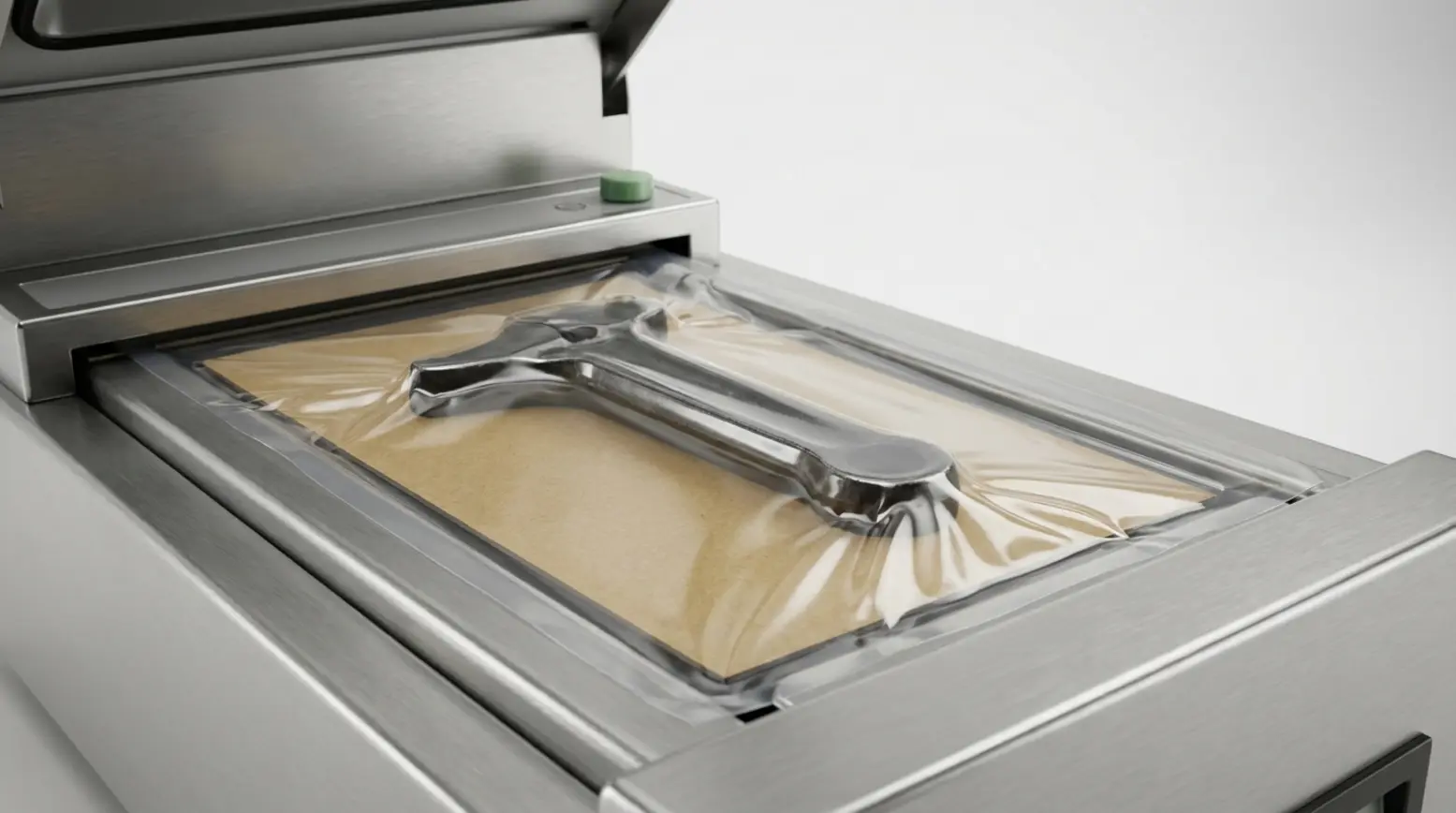
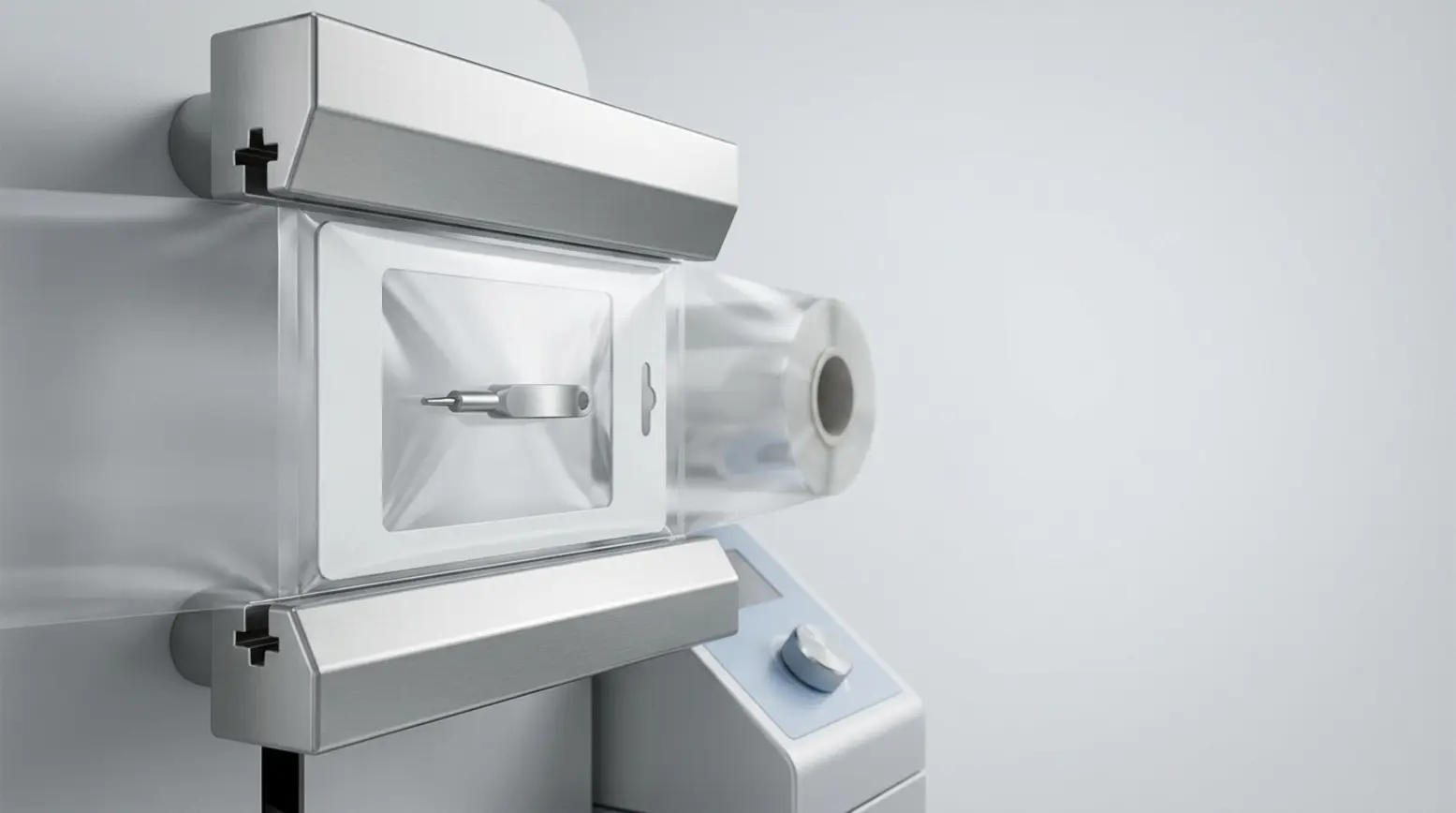
Wallet blister packaging machine guide for sizing, sealing, and automation

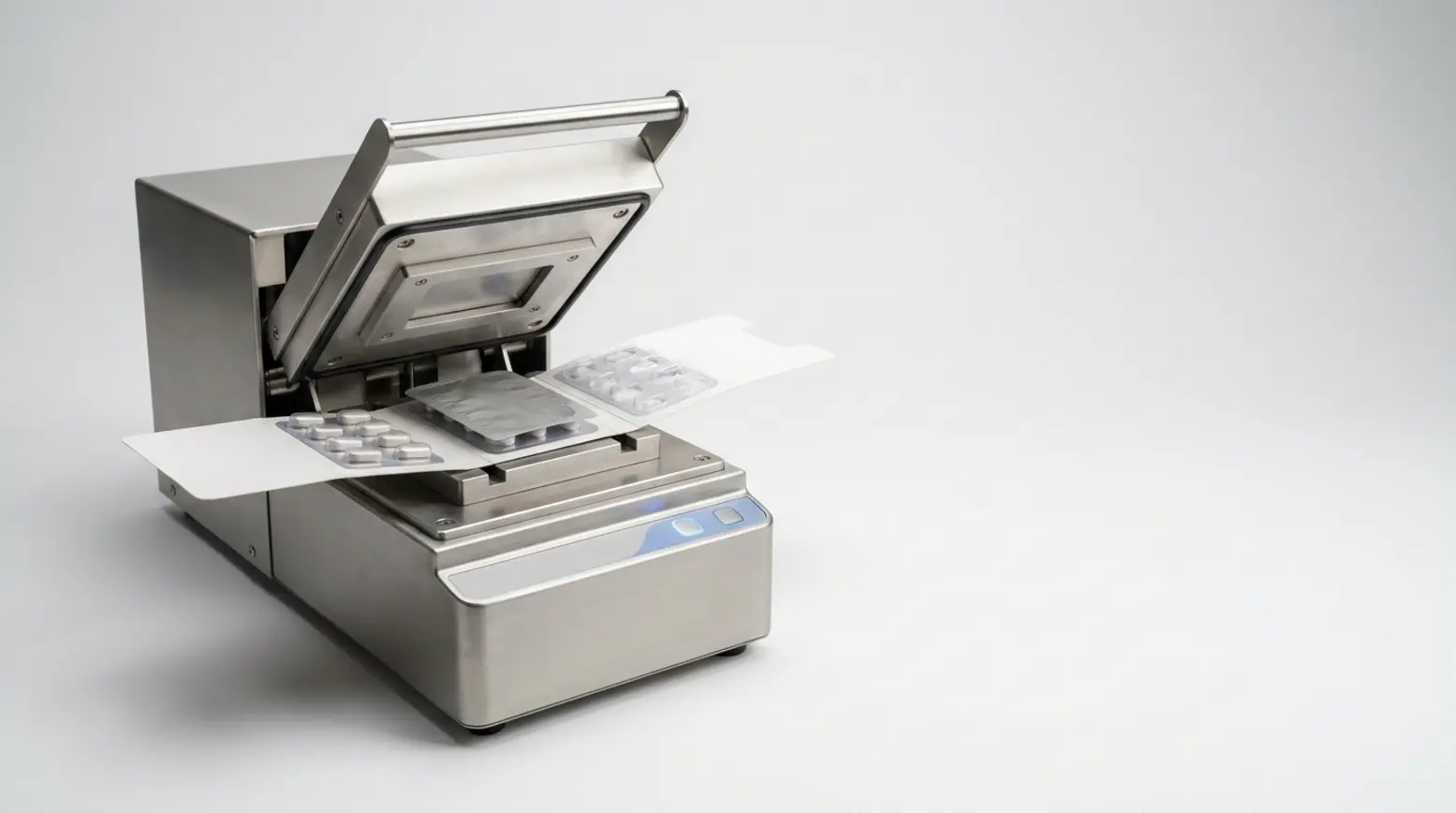
A wallet blister packaging machine seals the blister while the card is still open, so machine choice depends on the full open layout rather than the final folded pack. This means you need the open card size, fold positions, blister location, seal area, material thickness, and output target before you can choose the right equipment. If these details are clarified early on, the initial discussion about the machine becomes much faster and more productive.
• The machine works with the open wallet layout, so the closed pack size alone is not enough for an accurate specification.
• Fold lines, panel widths, and closing flaps can increase the tooling footprint and the sealing area.
• Blister position, seal flange, and total material thickness all affect alignment, pressure, and seal quality.
• A manual shuttle machine is often a practical starting point for low- to medium-volume wallet blister packaging.
• Heat-seal and cold-seal routes for wallet packs should be chosen based on the materials used and the process limitations.
What a wallet pack means for a wallet blister packaging machine
A wallet pack is a card structure that folds around or over a blister. In pharmaceutical wallet packaging, this format often provides extra space for product information, dosing details, or instructions. From an equipment perspective, however, it is primarily a sealing and tooling job. The card must stay in the correct position, the blister must sit in the right place, and the seal area must be fully supported during the cycle.
Wallet blister packaging starts as an open card. Some designs feature two panels, while others use a multi-panel blister wallet with extra folds or a closing tab. A fold-over wallet pack may look compact when closed, but its open format can take up significantly more room in the tooling area. This is exactly why a wallet blister packaging machine is selected based on the open layout and the sealing path.
A standard flat blister card is easier to define because it stays flat during sealing. In contrast, a wallet format introduces folds, flap positions, and sometimes trapped components like a leaflet. If you want a general refresher, our blister packaging guide explains the basic blister structure before you delve into wallet pack tooling and machine choice.
The machine essentially works with the opened format rather than just the closed pack, which is a key point for any buyer to understand. Even a small, closed pharmaceutical wallet pack concept might require a larger seal station because the open card could be wider, longer, or less centered than initially expected.
Why open dimensions matter on a wallet blister packaging machine
The full open width and height dictate the working area for a wallet blister packaging machine. These dimensions directly affect the seal station, tooling footprint, support surfaces, and part handling. If the wallet has several panels or a particularly long flap, the machine might require much more area than the closed pack suggests. Consequently, open dimensions must always come first when drafting your specifications.
Measure the card in its fully opened state, being sure to include every panel, flap, and extension present during the sealing process. Do not estimate these measurements based on the folded pack. A blister wallet machine must accommodate the actual card size during the seal cycle, making the true open footprint far more important than the pack's final visual appearance.
Record each fold position from one fixed edge and note the width of every panel. This demonstrates exactly how the blister sits in relation to the folds and indicates where support will be needed. If a fold line sits close to the seal area, wallet card sealing becomes much more sensitive, as pressure and support will likely require tighter control.
You should also check whether the closing flap sits inside the sealed area or close to it. In some cases, the flap remains well outside the seal path, while in others, it directly impacts the working space around the blister. As a result, a fold-over wallet pack often requires a larger tooling layout than its final closed shape suggests.
A simple example helps illustrate this point. A closed wallet may look narrow and easy to seal, but once opened, two side panels and a top flap can shift the blister away from the center of the card. The tooling then needs a greater support area around the blister, meaning the final wallet pack tooling becomes considerably larger than expected.
What to measure before you choose a wallet blister packaging machine
Gathering measurements is one of the most useful stages in any project. Good data turns a raw design idea into clear machine requirements. We typically review pack format, materials, seal area, and handling together because these factors directly influence machine choice and implementation. This aligns seamlessly with our machine specification and line integration approach, where the pack and the process are evaluated as a single, cohesive system.
Start by recording the outside dimensions of the blister, the cavity position, and the overall blister depth. These details dictate where the blister sits on the card and how it should be supported. If the cavity is noticeably off-center or the blister depth is quite high, the tooling may need extra support or a specialized pocket design to ensure stable handling.
Next, carefully define the seal flange or boundary around the blister. This constitutes the usable sealing area. It shows precisely where heat or pressure must be applied and determines how much flat surface is available to create a reliable seal. If the flange is narrow or sits too close to a fold, your optimal process window may become significantly smaller.
Then, record the card thickness, lidding thickness, and any extra trapped components placed inside the wallet. These could include a leaflet, coupon, insert, or an additional board layer. Even if the blister itself remains the same, the total stack height can change, which means the required setup and fold clearance will likely need adjustment.
Also, note the total number of panels, the presence of any leaflets, and the fold clearance. Having a leaflet inside the wallet during sealing alters the total thickness and affects handling. Adding a leaflet later, in a completely separate step, creates a distinctly different process. This distinction matters because a wallet blister sealer must be able to hold all parts perfectly flat and aligned throughout the cycle.
Physical samples help immensely. The best initial inputs are an opened sample, a closed sample, and a dimensional drawing if one is available. You should also include your output target, material specifications, and any known process limits. Providing this information yields a much clearer view of the pharmaceutical wallet pack machine requirements and considerably shortens the initial review.
• Item to measure: Full opened width and height. Why it matters: It establishes the seal station size and the overall tooling footprint.
• Item to measure: Fold positions and panel widths. Why it matters: It indicates exactly where support and pressure are needed during wallet card sealing.
• Item to measure: Blister outside dimensions, cavity position, and depth. Why it matters: It dictates tool location and ensures part stability.
• Item to measure: Seal flange or seal boundary. Why it matters: It clearly defines the usable sealing area.
• Item to measure: Card thickness and lidding thickness. Why it matters: It affects pressure distribution, heat transfer, and component fit.
• Item to measure: Leaflets or extra trapped components. Why it matters: It alters the stack thickness and impacts fold clearance.
• Item to measure: Number of panels and flap position. Why it matters: It can significantly increase the wallet pack tooling area well beyond the closed pack size.
How a wallet blister packaging machine holds parts in alignment during sealing
A wallet blister packaging machine must hold the card, blister, and lidding in repeatable alignment before the sealing starts. This is crucial because even the smallest movement can shift the seal, alter the blister position, or affect how the wallet folds later on. Excellent alignment consistently supports superior seal quality, uniform pack aesthetics, and far smoother downstream handling.
Tooling usually features fixed locations for each component. The card sits securely against physical stops or rests inside a custom pocket. The blister is placed in its designated location, and the lidding is carefully positioned so it fully covers the intended seal area. Once all parts are stable, the machine runs the seal cycle under tightly controlled conditions.
Repeatable alignment matters because wallet formats frequently combine complex folds, extra panels, and minimal sealing space. If the blister sits slightly off position, the seal boundary might move too close to a fold line. Alternatively, if the card shifts, the critical support around the seal area could be compromised. Since these small errors inevitably lead to waste or rework, stable part handling remains a core element of any blister wallet machine setup.
Adding a leaflet can also dramatically alter the process. When a leaflet sits inside the wallet during sealing, it can impact the total height, the fold behavior, and how flat the card lies within the tooling. Conversely, a separately inserted leaflet does not affect the sealing stack in the same way at all. Because of these variations, we always ask how and when the leaflet will be introduced.
For buyers, the practical view is relatively simple. Think of the process logically in this order: card position, blister position, lidding position, tool support, and finally, the seal cycle. If any single part of this sequence is unclear, the resulting machine selection becomes much less accurate.
Choosing the right wallet blister packaging machine for your production volume
Once the overall pack format is defined, the very next step is selecting the correct machine category. The right operational route depends entirely on your target output, the handling logic, and how highly repeatable your loading process can be. Our comprehensive range of pharmaceutical packaging machines covers manual, semi-automatic, rotary, and inline options, ensuring your final choice is guided by real-world project data.
A manual shuttle blister machine is frequently the most practical starting point for low- to medium-volume wallet blister packaging. It allows an operator to carefully place both the card and the blister, check their alignment, and execute a highly repeatable sealing cycle. This proves especially useful when formats are still changing, when flap placement requires manual attention, or when the entire process demands flexible loading. One excellent example is our Manual Shuttle cold seal machine; however, the perfect fit will always depend on the open card size, your chosen seal method, the required tooling, and your target output.
Semi-automatic and fully automatic rotary systems become increasingly relevant once your format is stable and loading can be repeated with very little variation. These machines drastically improve production rhythm and overall output by indexing the process in a far more structured way. For many wallet blister packaging projects, a rotary system represents the logical next step immediately following early development and validation work.
Automatic inline systems are designed for continuous processing, fitting perfectly when feeding, sealing, inspection, printing, scanning, or downstream handling all need to connect seamlessly in a single flow. This advanced route is generally best suited for steady, higher-volume programs. It also becomes highly relevant whenever manual transfers between steps begin creating bottlenecks in either output or quality control.
Fortunately, automation can also be added later. In a lot of projects, it is actually smarter to start out with a thoroughly stable sealing process, choosing to add automatic feeding, vision inspection, printing, or scanning only once the format and market demand are more firmly settled. This strategy keeps the project closely aligned with real production needs and deliberately avoids introducing unnecessary complexity too early.
• Machine category: Manual shuttle. Best fit: Low- to medium-volume runs, flexible loading requirements, frequently changing formats, and tasks needing careful setup.
• Machine category: Semi-automatic rotary. Best fit: Growing production outputs that feature more repeatable loading and consistent indexing.
• Machine category: Automatic rotary. Best fit: Higher, highly repeatable demand combined with more automated part handling.
• Machine category: Automatic inline. Best fit: Continuous processing setups that combine feeding, sealing, and downstream functions seamlessly into a single line.
Heat seal or cold seal for wallet packs
Both heat sealing and cold sealing are perfectly viable routes for wallet blister packaging, but making the correct choice largely depends on the specific materials and process limitations involved. A heat seal relies on a precise combination of temperature and pressure, whereas a cold-seal wallet pack utilizes a strictly pressure-based method. Since neither route is universally better, your decision must stem directly from your actual material combination and the physical pack structure.
A heat seal is generally suitable whenever your selected card, lidding, and underlying product processes can safely withstand the required temperatures. This is a very common route in pharmaceutical wallet packaging because the seal itself is formed through a highly controlled cycle of heat and pressure. Naturally, the exact machine settings will depend on the material behavior, the designated seal area, and the specific blister shape.
A cold seal may be considered whenever a pressure-based process better accommodates the pack's format or materials. It can beautifully support certain multi-panel blister wallet designs, free-standing packs, and various dispenser concepts. However, this approach should still be rigorously reviewed on a case-by-case basis. While a cold-seal wallet pack might fit one project perfectly, another project could easily perform much better using a traditional heat seal.
Ultimately, your material choice dictates the method because variables like card thickness, lidding type, blister shape, product sensitivity, and the total pack stack all deeply affect process behavior. Therefore, we always start by analyzing full pack data before confidently suggesting any specific sealing route or machine category.
Questions to prepare before you request a machine discussion
Before you even ask for a quotation, it is wise to prepare a concise project file containing your main technical inputs. This simple step makes the initial discussion much faster, effectively moving the conversation away from general design ideas and straight into concrete machine requirements. It also ensures that your procurement, engineering, and production teams are all working from the exact same set of information.
Start by identifying your current production volume. Define exactly what you need today, as this baseline will quickly guide whether manual, rotary, or inline logic makes the most sense right now. A lower starting volume generally supports a much simpler mechanical route, while higher and more stable demand naturally supports greater automation.
Then, think about what might realistically change during the project's next phase. Your output might grow, or the wallet design could gain extra panels. Leaflet content may evolve, or you might realize that vision inspection, printing, and scanning need to be added later on. Because these potential changes heavily impact tooling, machine setup, and the overall line scope, it always helps to mention them as early as possible.
Be very clear about which handling steps will remain strictly manual. These could include loading cards, placing blisters into the tooling, adding leaflets by hand, or visually checking part orientation. Manual steps are very often the right choice at the start of a project, but they must be clearly defined to guarantee that the machine route perfectly matches your actual real-world workflow.
Finally, carefully note any specific steps that might require automatic feeding, vision inspection, printing, or barcode scanning. While these functions are incredibly important when they actively support a broader production plan, they do not necessarily need to be added before the basic sealing process is proven stable. First, define your wallet format and sealing method; only then should you define the extra automated functions.
FAQ about wallet blister packaging machines
What is the difference between wallet blister packaging and a flat blister card?
A flat blister card simply stays flat during sealing. In contrast, wallet blister packaging utilizes a card that actively folds around or over the blister itself. This introduces extra panels, distinct fold lines, closing flaps, and sometimes trapped parts like a patient leaflet. Because of these added elements, the tooling and the sealing setup are usually far more detailed.
Why does the opened wallet size matter more than the closed pack size?
The machine seals the pack while it remains entirely open. Therefore, the full opened width and height accurately define the necessary working area, the seal station size, and the complete tooling footprint. While a closed pack might look small, its open card equivalent often demands considerably more space within the machine.
Is a manual shuttle blister machine enough for a wallet pack project?
Often, yes, it is perfectly sufficient. A manual shuttle blister machine offers a robust starting point for low- to medium-volume work, frequently changing formats, and applications requiring careful hand loading. It proves especially useful whenever complex alignment and flap placement require close, manual attention during setup or early production runs.
When should a pharma wallet pack machine move to rotary or inline?
A rotary machine becomes highly relevant when the format is thoroughly stable and the loading process can be safely repeated at a much higher output. Inline equipment becomes relevant when feeding, sealing, inspection, printing, or part transfer steps must all run as one seamless, continuous process. Ultimately, any move toward these automated routes should strictly follow real-world demand and practical handling logic.
Does every wallet pack need cold seal?
No, not necessarily. Some wallet packs naturally fit a heat seal better, whereas others perform optimally with a cold seal. The correct route ultimately depends on the specific card, the lidding, the blister structure, and your own process limits. A cold seal is simply one great option, not a universal rule.
What should I send for a first machine review?
Ideally, send an opened sample, a closed sample, and a detailed dimensional drawing if one is possible. You should also include the open card size, fold positions, panel widths, blister outside dimensions, cavity position, blister depth, designated seal boundary, card thickness, lidding thickness, leaflet details, total panel count, and your target output.
Next step for your wallet project
If your format is still in its early stages, we can gladly review the initial concept and help translate it into clear, actionable machine requirements. However, if your format, materials, and target output are already firmly defined, you can request a free Quick Scan or discuss your project with our team today. Providing a drawing, an opened sample, and a closed sample makes that initial discussion far more useful, as these elements provide a vastly better basis for accurate machine selection, precise tooling fit, and long-term installation support.