Medical device blister sealing, how to move from prototype to production

Medical device blister sealing moves from prototype to production by replacing manual labor with a controlled machine process. Although a hand-sealed sample can demonstrate that a packaging design is feasible, it cannot guarantee stable output for a full shift. To achieve repeatable results, teams need accurate package data, stable tooling, fixed sealing settings, clear quality checks, and a machine that accommodates the pack, meets the output target, and aligns with future automation plans.
• A good prototype seal is merely a starting point, as manual timing, pressure, and package position can vary from sample to sample.
• Repeatable production relies on controlled heat, pressure, sealing time, package support, and consistent machine cycles.
• Before selecting a machine, gather samples, drawings, materials, seal area details, current settings (if known), and approved testing criteria.
• Tooling design is crucial because tray support, flange shape, and outer geometry directly affect sealing contact and package stability.
• While validation remains the responsibility of the customer’s quality system, we provide support for machine selection, installation, and line integration.
Why medical device blister sealing changes from prototype to production
A hand-sealed pack often relies on operator feel, tray position, and sealing time. Because these factors can fluctuate, a single acceptable sample does not prove that the same result will hold up over a long shift. In production, medical device blister sealing must operate with defined settings and a repeatable cycle. This allows teams to control the process more effectively and evaluate results in a truly consistent manner.
With a blister sealing machine, manual actions are replaced by controlled heat, pressure, dwell time, and precise package location. Dwell time refers to how long the seal remains under heat. Consequently, device blister sealing becomes much easier to repeat, monitor, and optimize as production volumes grow.
What a hand-sealed prototype can hide
Prototype work can mask minor variations that become critical later on. A tray might sit slightly off-center, or the sealing edge could lack support in one corner. Furthermore, an operator may apply heat a little longer on one sample than on the next. While you might still end up with a usable package, this does not confirm whether the process will remain stable during routine production. For this reason, early samples should be treated merely as a proof of concept, rather than as evidence of a fully qualified production process.
What a machine process must control
A machine process must strictly control the primary sealing inputs during every cycle. These include temperature, pressure, dwell time, tray position, and tooling support. The objective is straightforward: every package must experience identical conditions to ensure predictable quality. This principle applies whether you are using a prototype packaging machine for early testing, a medical tray sealer for batch work, or larger medical packaging equipment for higher output.
What to record before medical device blister sealing moves to a machine
Before requesting equipment advice, gather all the key facts regarding the package and the current process. This preparation saves time by eliminating incorrect assumptions and provides a solid foundation for technical decisions. It also makes it much easier to compare machine classes, tooling requirements, and automation options in a practical way.
• Package data: tray or blister material, lidding material, coating, seal flange width, usable seal area, and full outer dimensions.
• Process data: current sealing temperature, pressure, and dwell time (if known and controlled), plus the prototype support or tooling method used.
• Quality data: approved visual checks, seal strength tests, and package integrity tests already in use by the quality team.
• Project data: target output, expected batch size, future automation plans, and any integration needs for printing, scanning, transferring, or inspection.
Pack data to document
Start with the package itself. Record the tray or blister material, the lidding material, the coating type, the flange size, and the full package dimensions. The seal area is particularly important because sealing medical device trays depends on how the flange shape and outer geometry interact with the sealing tool. If the sealing edge is narrow or uneven, the process leaves little room for variation, meaning the tooling must be exceptionally precise.
Process data to document
Write down any sealing values that are already known, including temperature, pressure, and dwell time. You should also record how the prototype was held or supported during sealing, as the support method significantly influences the final result. If a hand fixture or simple jig was used, document that as well. This information helps highlight what might change when the process transitions to a medical device packaging machine.
Quality checks to document
Your quality team must define what is considered acceptable before routine production begins. Keep a record of the visual inspection rules, any seal strength testing, and any leak or integrity tests currently in use. This step is critical because a package can look perfectly fine yet still fail a seal performance test. Clear documentation supports better machine selection and makes blister sealing validation much easier to plan.
How tooling affects medical device blister sealing repeatability
Tooling is frequently the point where prototype work and production diverge. Medical blister tooling must support the tray in precisely the right places so the package remains stable during sealing. If the support is inadequate, pressure may not distribute evenly across the full flange during every cycle. Ultimately, this can lead to uneven seals, weak areas, or even damage to the tray.
The tray shape, wall form, sealing edge width, and complete outer geometry all impact tooling design. A rigid tray might require support beneath key points to prevent flexing, whereas a shallow blister may need careful positional control to keep the lid perfectly aligned. Therefore, device package sealing depends on much more than temperature alone; the package and the tooling must work seamlessly together.
Why tray support and flange geometry matter
During sealing, the tray must remain perfectly stable. If one side lacks adequate support, the tray can shift or bend, preventing the lid from contacting the sealing edge evenly. This imbalance can create strong contact in one area and weak contact in another. High-quality tooling closely follows the package geometry and supports the sealing edge without damaging the tray body. By securing the tray properly, the machine has a much better chance of delivering repeatable results.
Why prototype settings do not equal production settings
Prototype figures should not be directly copied into production. A hand-sealed test often uses a different support method, an altered cycle time, and a different heat path than an automated machine process. Because of these differences, prototype settings serve merely as a starting point. They help determine where to begin testing, but they do not guarantee a validated production process. Medical device blister sealing requires rigorous testing in a real machine context, utilizing the final tooling and defined quality checks.
Choosing the right machine for medical device blister sealing volume and control
The appropriate machine class depends on output requirements, tooling specifications, inspection needs, and future automation plans. While some projects begin with sample work and low batch volumes, others demand higher output and stronger integration right from the start. The best choice always stems from actual package data and production goals, rather than just machine size.
We offer a range of medical and pharmaceutical blister packaging machines developed in partnership with Starview. This lineup includes manual tabletop and single-station shuttle machines, rotary systems, and automatic inline equipment. If you are still comparing your options, our guide on choosing a blister packaging machine can help you evaluate the different machine classes in a structured manner.
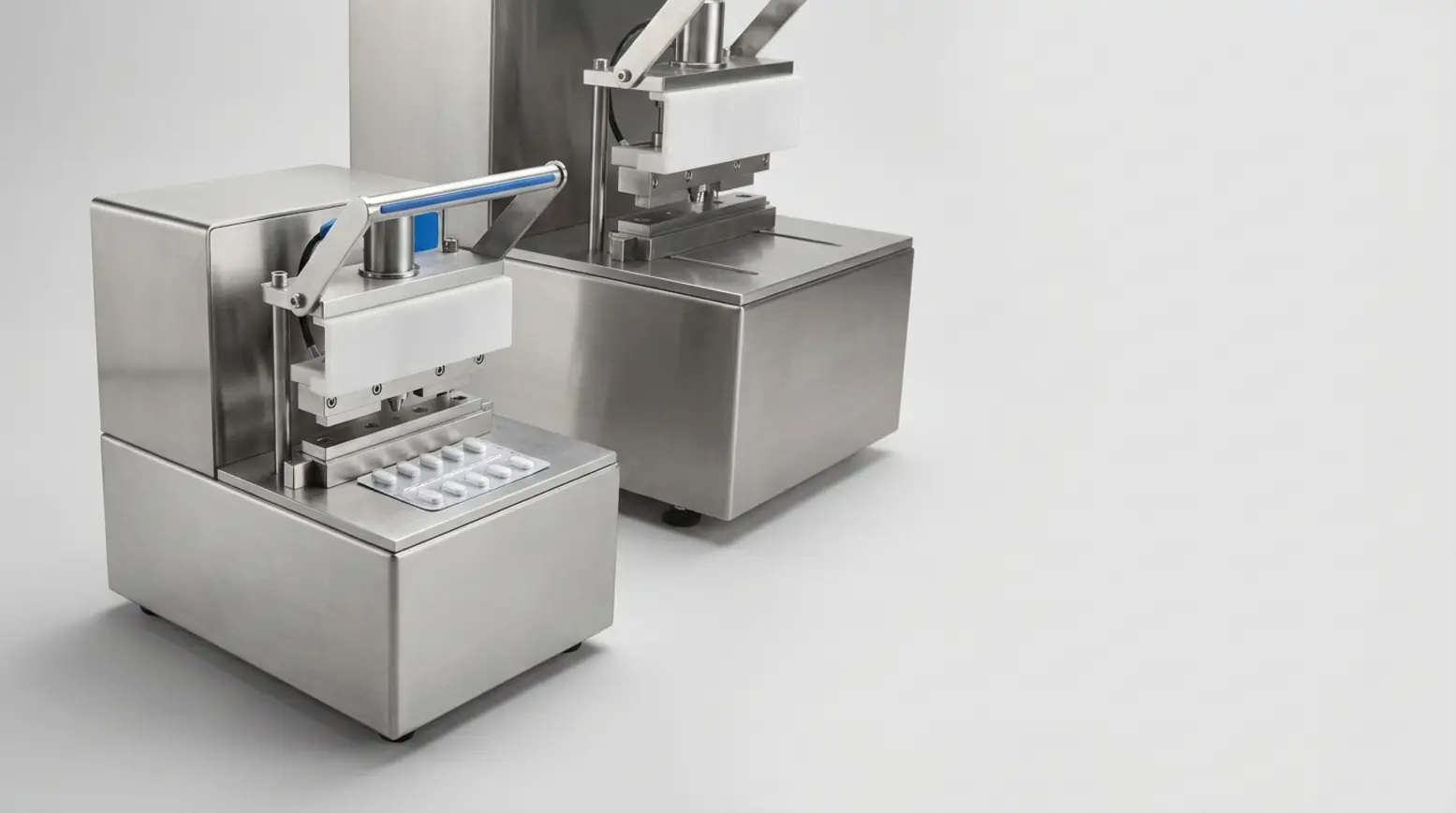
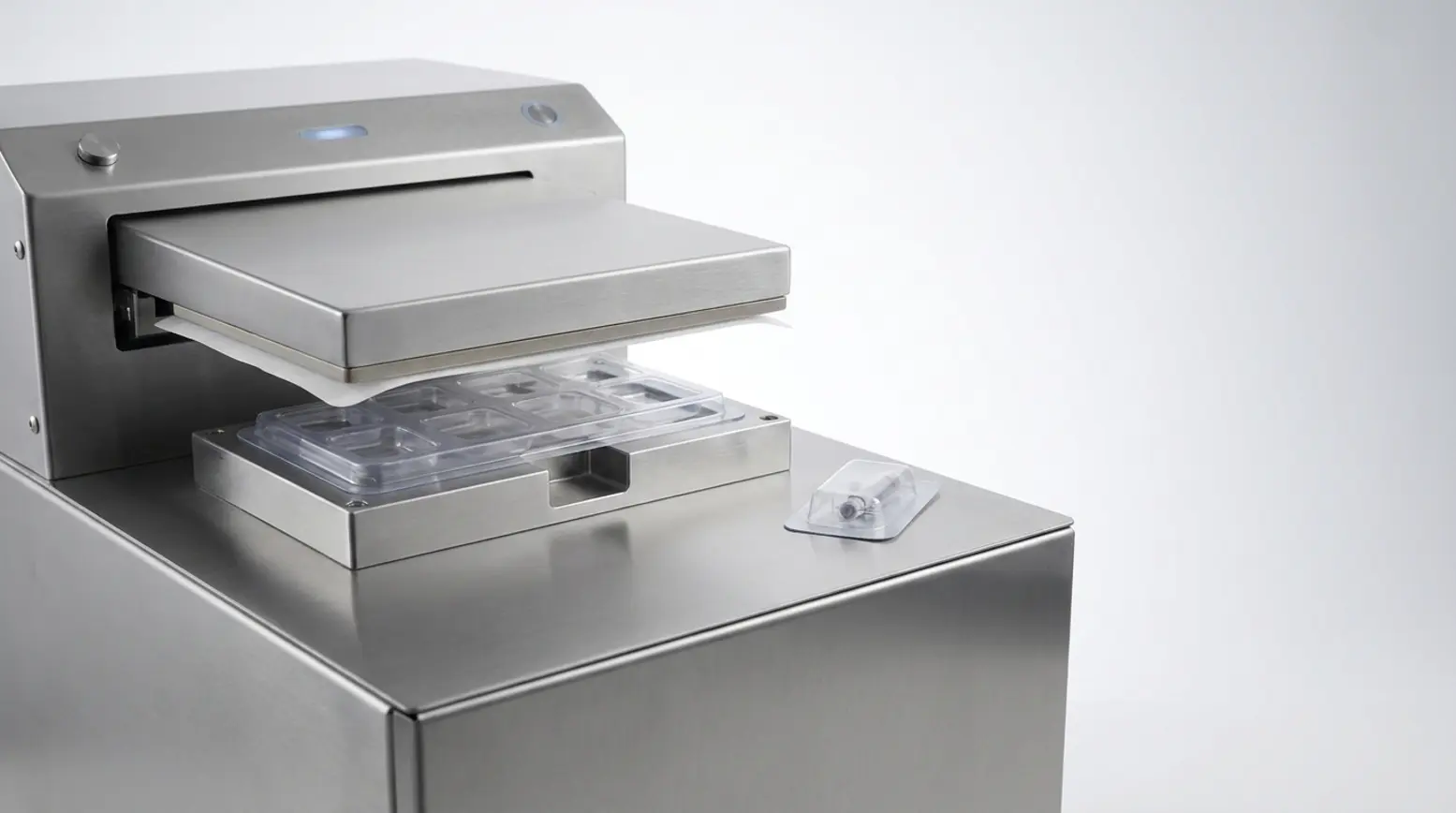
• Manual table top: best for prototypes and samples, with low output and limited automation.
• Manual shuttle: best for prototypes and small batches, with controlled sealing and some basic print or inspection options.
• Rotary: best for medium volume and repeated multi-station output, with wider automation options.
• Automatic inline: best for high volume and continuous handling, with stronger line integration for feeders, scanning, printing, and vision systems.
Manual table top and manual shuttle for prototypes and small batches
These machines are ideal for early development, sample creation, and smaller production runs. They are particularly useful when a team is still learning how the tray, lid, and seal area behave under a controlled process. A prototype packaging machine or manual shuttle can also facilitate material trials, format checks, and low-volume device blister sealing work where flexibility is more important than speed.
Rotary machines for repeated medium to higher output
Rotary systems are perfectly suited for repeated, multi-station production. They are highly beneficial when output is increasing and the process demands stronger repeatability from one cycle to the next. For many teams, this is the stage where labor efficiency and process control significantly improve together. If a project features a stable package design and consistent order volumes, rotary equipment is often a highly practical next step.
Automatic inline for continuous high-volume handling
Automatic inline systems make sense when material handling is continuous and the production line requires deep integration. These systems accommodate higher volumes and connected workflows, yet they must still be chosen based on the package, the tooling, and the necessary inspection steps. A sterile packaging machine or other automated medical packaging equipment should never be selected solely for its speed; the package and the process must always remain the primary drivers.
When extra automation becomes useful
As production volume grows, additional automation can greatly reduce manual handling and improve overall control. This might include the addition of feeders, transfer systems, printing hardware, scanners, or a packaging vision system. The right level of automation depends on the package design, the target output, and the specific data points or quality checks the line must manage. Consequently, automation should always be integrated for a clear purpose and directly linked to the needs of the process.
Medical device blister sealing inspection, validation, and control
Inspection protocols should always answer a specific question. Some checks are purely visual, others measure seal strength, and some evaluate overall package integrity. Because these are fundamentally different controls, they must remain clearly defined. This distinction is vital for medical seal inspection; confusing different test types can quickly lead to poor process decisions.
ISO 11607-2 serves as a key standard for developing and validating the forming, sealing, and assembly processes for terminally sterilized medical device packaging. Terminally sterilized means the enclosed product is sterilized within its final package. ASTM methods are also highly useful because they help operators separate visual seal inspection from measured seal strength and leak testing. In practice, every quality check must have a single, clearly defined purpose.
What visual systems can and cannot check
A packaging vision system can thoroughly inspect visible and measurable features. It can verify part presence, confirm part position, read printed text, assess code quality, check label placement, or ensure a defined seal appearance. While this technology can be incredibly useful in device blister sealing lines, a camera system should never be treated as proof of seal integrity unless the customer’s validated method explicitly supports that exact application.
Keep visual inspection separate from seal integrity claims
This point is crucial for engineering, operations, and procurement teams. A seal that looks flawless is not automatically strong enough or completely leak-tight. Therefore, visual inspection, seal strength testing, and package integrity testing must remain strictly separate unless an approved method officially links them. Taking this clear, structured approach supports better blister sealing validation and significantly reduces the risk of false confidence in the packaging process.
Where blister sealing validation fits
Validation inherently belongs to the customer’s quality management system. While we can provide expert support for machine selection, installation, and process integration, the customer ultimately owns the validation plan, the acceptance criteria, and the final approval. Keeping this responsibility clearly defined from the very beginning helps projects move forward smoothly with fewer misunderstandings.
Managing design changes after installation
Changes after a product launch are incredibly common. A new tray wall, a different lidding material, an alternative coating, or a modified flange width can all impact tooling requirements and previously approved settings. Because of this, medical device blister sealing should always be planned with future modifications in mind. A process that is stable today may require a comprehensive review tomorrow if the package geometry or material composition changes.
Post-delivery support is critical because the setup process does not end the moment the equipment arrives. We assist with both installation and line integration, and we provide ongoing support for later updates whenever the package or process evolves. You can read more about our extensive approach to machine implementation to better plan the entire journey from the initial equipment choice to final line fit.
Common changes that affect tooling and settings
Even a minor package revision can profoundly affect the sealing process. If the flange becomes narrower, the usable seal area immediately changes. If the lid material or the coating is swapped out, the approved sealing window might shift as well. Furthermore, if the tray wall becomes more flexible, the support points within the tool may need to be redesigned. Any of these changes should automatically trigger a careful review of the tooling, operational settings, and quality checks.
Why support after installation matters
Installation is merely one step in a much longer process. Integrating the machine with feeders, printers, scanners, transfer systems, or inspection devices can require significant effort before stable output is achieved. Excellent post-installation support helps the production line transition into routine operation in a highly controlled manner. It also enables teams to respond much faster when package updates inevitably affect device package sealing performance.
Questions buyers ask about medical device blister sealing
Can we scale a hand-sealed prototype straight to a production machine? A direct transfer should never be assumed. The package, tooling, machine cycle, and quality requirements must all be rigorously tested within the actual production context. While a hand-sealed sample is undoubtedly useful, it does not guarantee repeatability.
Which machine class fits our volume? Manual tabletop and shuttle machines are ideal for prototypes, samples, and small batches. Rotary systems are designed for repeated, medium-to-high output. Automatic inline systems are best suited for continuous, high-volume handling and broader integration needs.
Can a vision system confirm seal integrity? A vision system can expertly inspect visible features such as part presence, position, print legibility, or defined seal appearance. However, seal integrity verification must follow the customer’s validated inspection method and should never be assumed based on camera inspection alone.
What should we send before asking for a machine recommendation? Please provide current samples, package drawings, tray and lidding materials, coating details, flange and seal area data, current settings (if known), approved testing criteria, target output, and any future automation needs. Supplying this information establishes a much stronger technical foundation for machine and tooling advice.
When should tooling be reviewed again? Tooling must be reviewed whenever the tray, lid, coating, flange width, or overall package geometry changes. It should also be re-evaluated if output targets increase or if new inspection devices are integrated into the production line.
Next step for your project
If you are transitioning from a hand-sealed sample to full production, start by gathering accurate package and process data. This approach creates a clear, straightforward path for selecting tooling, machine types, inspection plans, and integration options. When you are ready, you can share your samples and drawings with us, alongside your materials, approved testing criteria, current output requirements, and future automation plans, so we can help you choose the ideal system.