Face seal vs trapped blister: key differences in packaging

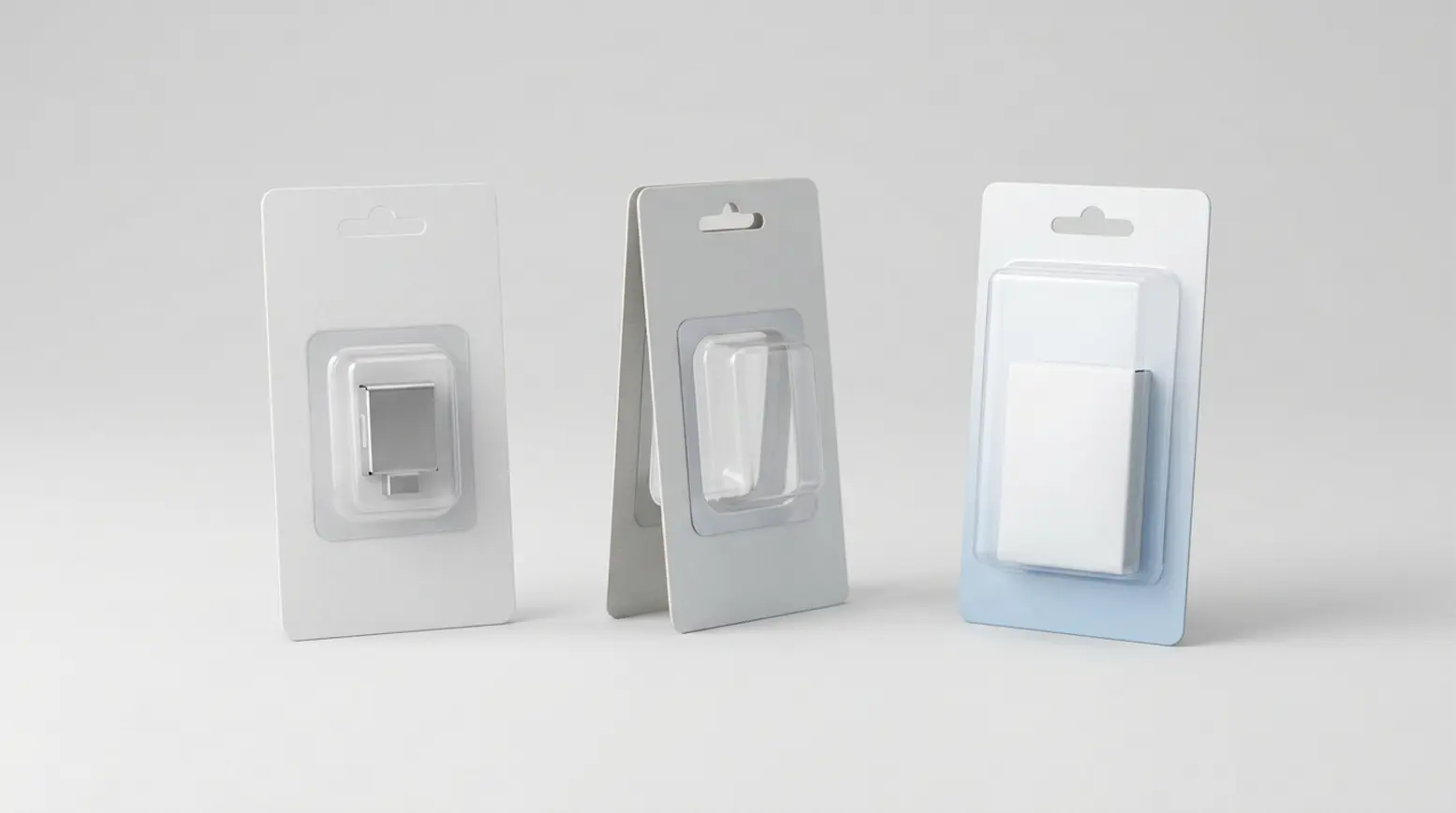
Face seal, trapped, and full face blister packs differ primarily in where the blister joins the card. In a face seal blister, the flange seals directly to the front of a single card. In trapped blister packaging, the flange sits between two layers of board. In a full face blister, the clear plastic covers most or all of the card front, which often increases both material usage and tool size. When making face seal vs. trapped blister decisions, these differences matter because the pack style influences card selection, blister sealing tooling, machine compatibility, and the optimal production setup. For broader context, our guide to blister packaging basics explains the primary components of a blister pack.
• The primary difference lies in the seal or bond location, as this dictates tooling and machine compatibility.
• A face seal blister typically requires a heat-seal blister card or another card surface capable of supporting the necessary bond.
• Trapped blister packaging utilizes two board layers, meaning the board-to-board joining method must be defined early on.
• A full face blister frequently uses more plastic and requires a larger tool footprint, even when the underlying sealing concept is similar to a face seal.
• The optimal choice depends on the product's shape, display requirements, opening behavior, production volume, and changeover frequency.
Face seal vs. trapped blister: what buyers need to compare first
On the retail shelf, these blister pack types can look quite similar, but they behave very differently in production. The fundamental questions are simple: where does the pack seal, what card or board construction is necessary, how large is the actual sealing area, and will that area fit the chosen machine? Consequently, face seal vs. trapped blister comparisons should start with sealing geometry and expected output rather than appearance alone. Taking this approach helps buyers avoid the common mistake of finalizing the pack style first and checking machine limitations too late.
Procurement teams often want a quick answer regarding cost and complexity, while engineering teams typically need more detail on blister card construction, sealing methods, and change parts. Both perspectives are highly valuable, so the best evaluations bring them together early in the process. This collaborative approach allows you to accurately judge materials, tooling, and production impacts before any tooling is officially released.
Face seal vs. trapped blister: definitions of the three constructions
A face seal blister is a formed plastic blister featuring a flange around its cavity. This flange seals directly to the front of the card, fully enclosing the product area. In most cases, the card's surface must support the required heat-seal bond, making the choice of a heat-seal blister card highly important. Flange width and shape are also critical factors, as the sealing tool must press precisely along the true bond path.
Trapped blister packaging secures the blister flange between two layers of board. With this retail blister construction, the flange does not need to seal directly to the front of a coated card like it would in a face seal blister. However, the pack still requires a reliable method for joining the two board layers. This ensures the finished package remains securely closed and performs as intended throughout production and consumer use.
A full face blister utilizes a clear formed part that covers most, if not all, of the card's front. While the underlying sealing concept may be similar to that of a face seal blister, the plastic front is significantly larger. As a result, material usage shifts and the tool footprint typically grows. This becomes one of the primary differences to weigh in a sealed vs. trapped blister review when a full face option is also under consideration.
Face seal vs. trapped blister: where the seal sits and why tooling changes
The seal's location is the core of this comparison. In a face seal blister, the seal sits exactly where the blister flange meets the front of the card. In trapped blister packaging, the flange is captured between two board layers, meaning the critical joining path is the board-to-board bond surrounding that flange. For a full face blister, the bonding method may still follow a face seal approach, but the larger plastic face significantly changes the area the tooling must cover.
This is exactly why blister sealing tooling must match the true flange or bonding geometry, rather than just the outer dimensions of the card. A large card does not necessarily equate to a large seal area, and having the same card outline does not guarantee that the same tool can be used. If the flange width changes, the seal path changes with it. Similarly, if the flange shape changes, the tool usually must change as well. Therefore, a thorough tooling review should always focus on the true bond path first and the outer card dimensions second.
A simple example helps illustrate this point. A product family might maintain a common card footprint to ensure consistency on the retail shelf. Even then, introducing a new product shape can require a deeper cavity, a new flange outline, a different board die-cut, and entirely new sealing tooling. While a shared card size can simplify certain aspects of the process, it does not eliminate the need for tooling changes altogether.
Face seal vs. trapped blister: machine consequences by construction
The required sealing area must fit perfectly within the usable sealing space of the selected machine. Teams sometimes overlook this crucial detail because they focus solely on the outer card dimensions. The machine must be capable of handling the true seal shape, the actual blister size, and the specific tooling layout. Because of this, face seal vs. trapped blister choices should always include an early machine-fit evaluation.
Card requirements also vary by construction. Face seal packs generally need a card surface formulated to support the required seal to the blister flange. Trapped packs work differently since the flange is captured between board layers, yet those boards still require a clearly defined joining method. It is important to note that trapped construction and cold sealing are not the same thing, so these two topics should remain distinct. If you would like more background, our article on heat and cold sealing methods explains the difference in simple terms.
A single product change can affect multiple components simultaneously. The blister cavity might require a new shape, while the flange could need a modified outline. The board die-cut may shift, and the sealing tool will likely need to adapt as well. This cascade of changes is critical in daily operations, as each adjustment can impact setup times, spare parts inventory, and overall process repeatability.
Production volume is another vital consideration. Development work, short runs, and frequent format changes often pair best with manual tabletop units or single-station shuttle systems. Conversely, medium to high-volume repeat runs can easily justify rotary or highly automated equipment, especially as output and consistency become top priorities. Our diverse range of retail blister packaging machines supports various production volumes and multiple retail blister constructions. While some Starview rotary blister sealers can accommodate several formats, every proposed pack must still be rigorously checked against the machine category, usable sealing area, and tooling layout.
Comparison table: face seal, trapped, and full face blister
| Construction | Seal location | Card requirement | Tooling consequence | Typical use |
|---|---|---|---|---|
| Face seal blister | Blister flange seals directly to the front of a single card | Usually needs a card surface that supports heat sealing | Tool must match the flange width and the true seal path | Retail packs where product visibility is paramount |
| Trapped blister packaging | Blister flange sits securely between two board layers | Requires two board layers and a defined board-to-board joining method | Tooling follows the board-to-board bond shape and the pack layout | Retail packs where board construction is an integral part of the design |
| Full face blister | Often uses a face seal-style bond, with clear plastic covering most or all of the card front | Often has card requirements similar to a face seal, depending on the design | The larger plastic face increases the tool footprint and total material area | Retail packs demanding a large clear front and strong product display |
Materials and recyclability
Each construction naturally changes material usage. A face seal typically uses a coated card and a formed blister, whereas trapped packaging adds a second layer of board. A full face pack requires a significantly larger formed plastic area, meaning the plastic component is notably heavier than in a standard face seal blister. This structural shift impacts both material planning and overall pack weight, although the exact results will depend on the final design.
Recyclability demands a careful review in every case. It heavily depends on the exact materials, coatings, and adhesives used, as well as how easily the components separate and the capabilities of local recycling routes. Therefore, none of these formats should be described as automatically recyclable. The true answer only emerges when evaluating the final pack specification alongside the applicable local waste stream.
Face seal vs. trapped blister: managing format changes across a product family
Using a common card footprint can make a product family much easier to manage. It promotes visual consistency on the shelf and reduces the number of distinct card sizes within your system, simplifying both purchasing and material handling. Nevertheless, it remains essential to evaluate every individual product shape in detail.
A newly introduced product might keep the same card size yet still require a new blister cavity, a different flange, a revised board die-cut, and a completely new sealing tool. This scenario is incredibly common in face seal vs. trapped blister projects, primarily because the visible card format may remain stable even as the actual bonding geometry shifts. For this reason, conducting early requirement checks ultimately saves time and helps teams avoid costly redesigns later on.
Because we deeply understand both pack construction and sealing machinery, we can expertly match the right equipment to your specific format. Working this way ensures that complex questions regarding seal shape, materials, expected output, and change parts are resolved early on by determining requirements together.
How to choose the right construction and machine setup
Start by examining the product and its specific display needs. Carefully check its size, shape, weight, and exactly how much of the item should remain visible to the consumer. While shelf presentation is undeniably important, it must be reviewed alongside cavity shape and available sealing space; appearance alone does not dictate the best possible package.
Next, evaluate the desired opening behavior and your broader material strategy. Decide precisely how the package should open and which material direction your team intends to pursue. Because these strategic choices directly influence board selection, blister form, and the ultimate joining method, they must be clearly defined before any tooling is released.
After that, match your expected production volume with your anticipated changeover frequency. Short runs, market testing, and frequent product changes generally fit better with simpler machine categories. Conversely, stable repeat runs at medium or high volumes often justify an investment in rotary or highly automated systems, as long-term output and repeatability become increasingly critical.
The final step is transitioning your focus from package construction to the appropriate machine category. A manual or shuttle system may be perfectly adequate for product development or low-output runs, whereas a rotary or inline solution better suits stable demand and minimal format changes. Ultimately, the best decision stems from analyzing the true pack shape, the exact sealing area, and your anticipated production patterns.
Questions buyers often ask
Does trapped blister packaging always avoid heat sealing?
No, it does not. While the blister flange is securely trapped between board layers and avoids sealing directly to a coated blister card like a face seal blister would, the package still requires a defined method for joining those board layers together. The chosen method must perfectly align with the overall design, material selections, and production processes.
Is a full face blister the same as a face seal blister?
No, they are distinct. While a full face blister can utilize a similar bonding principle, the clear plastic component covers most or all of the card's front. Due to this larger plastic surface area, the required tool footprint changes significantly. This shift subsequently affects material usage, tooling requirements, and the final machine setup.
Can one machine run several retail blister pack types?
Sometimes, yes. This capability depends on the specific machine category, tooling design, seal geometry, pack size, and your overarching production needs. While some robust rotary systems can successfully support several different retail blister constructions, every intended format should be thoroughly checked against the machine's usable sealing area and tooling layout before a final equipment choice is finalized.
What is the main practical difference in a sealed vs. trapped blister choice?
The primary difference lies in the bond path. A sealed pack, such as a face seal blister, directly bonds the flange to the front face of the card. A trapped pack captures that flange between two layers of board and relies entirely on a defined board-to-board joining method. Because the bond path fundamentally changes, the tooling, board construction, and machine compatibility will naturally change along with it.
When should a team check machine fit?
The best time to conduct a machine fit check is well before the tooling is finalized. Performing these early evaluations helps confirm the real sealing area, the exact tool footprint, and any specific change part requirements. Proactively assessing these factors drastically reduces the risk of choosing a packaging format that later proves difficult to run on your planned equipment.
Next steps for your pack and volume
If you are currently comparing face seal blister, trapped blister packaging, and full face blister options, the best next step is to review your true pack design, the required seal geometry, and your expected output all together. Taking a holistic view is almost always faster and more effective than choosing a format first and discovering machine limitations later. Feel free to share your specific pack and volume needs through our contact page, and we can discuss a complimentary Quick Scan.