Blister to carton line handover, designing reliable pharma packaging lines

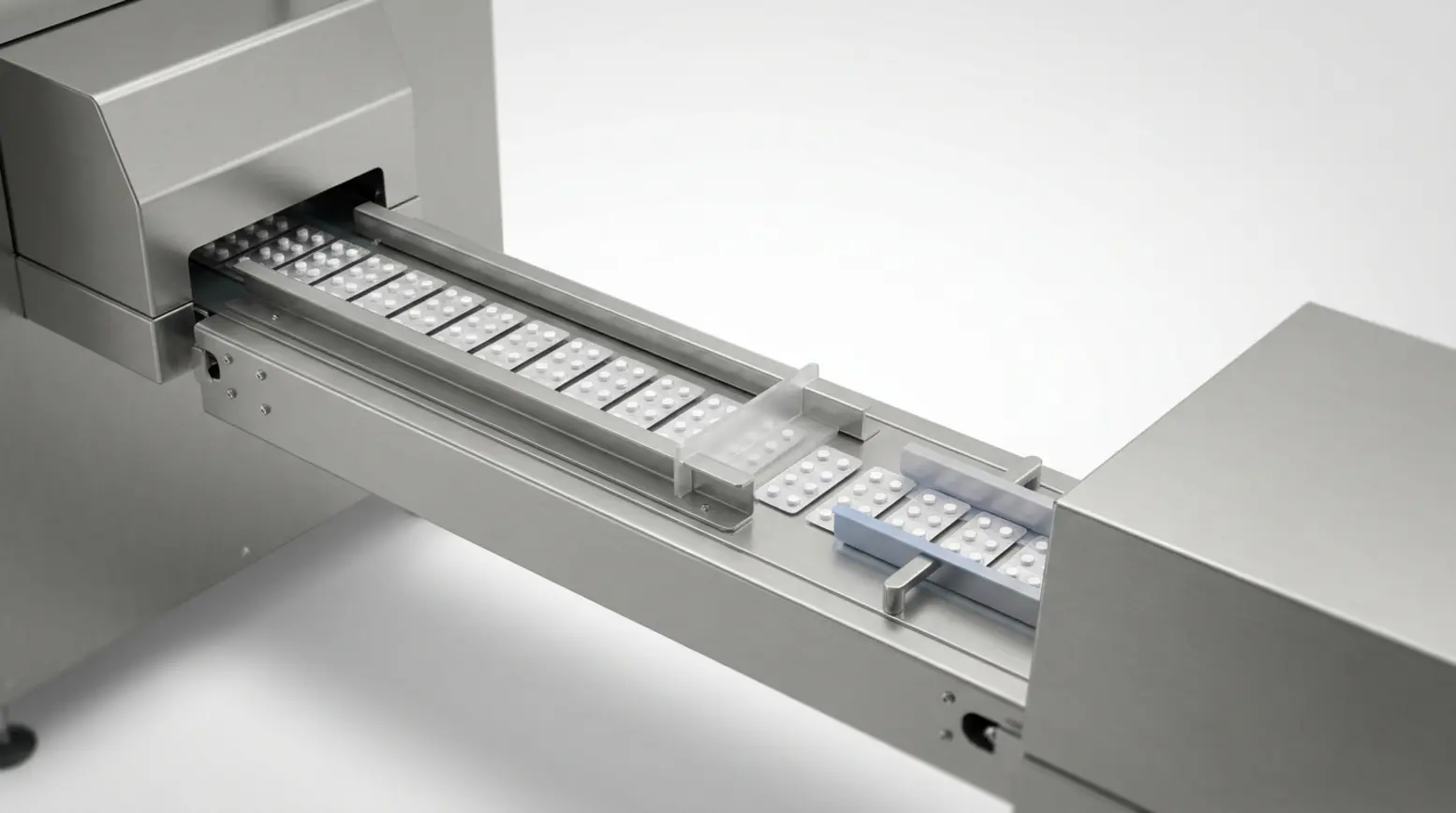
The handover from a blister machine to a cartoner works best when both machines and the space between them are planned as a single, unified process. A stable transfer depends on clear pack orientation, sufficient temporary buffer space, proper spacing, and precise control signals that tell each machine when to run, wait, stop, and restart. By defining these points early, teams can reduce jams, avoid forced stops, and minimize restart delays well before installation.
• The handover zone requires its own engineering review because transfer problems can easily disrupt the entire line.
• Buffering provides a brief breathing space between machines that do not stop and restart in the exact same way.
• Pack shape, stiffness, friction, and size all affect how blisters move toward the cartoner infeed.
• Establishing clear ownership for rejects, changeovers, and restart logic helps avoid costly delays during testing and production.
• Using real pack samples, accurate layout data, and realistic test conditions leads to better packaging line integration decisions.
Why the blister-to-carton line handover deserves its own design review
The handover between the blister machine and the cartoner may seem like a minor part of the line, but it has a massive impact on daily performance. The upstream machine, the transfer path, and the cartoner must function as a single process; after all, a good machine alone does not guarantee a stable result downstream. During the blister-to-carton line handover, the main goal is simple: sealed blisters must arrive in the correct orientation, at the proper pace, and with machine signals that accurately reflect the real flow of product.
This section of the line also brings together layout, controls, temporary storage, and operator access. If any of these aspects are overlooked, the result can be an unstable cartoner blister feed, blocked transfer paths, or lengthy restart times after a stoppage. That is why we evaluate the entire line when helping customers choose pharmaceutical blister machines. Ultimately, the selected machine dictates the transfer conditions that follow.
The physical path of the blister-to-carton line handover
From sealed blister to transfer
What leaves the blister machine is a sealed pack that must remain under total control from the very first moment after discharge. While the exact sequence depends on the line and pack format, the basic path usually remains the same: the blister leaves the machine, enters a transfer section, moves through a blister accumulation or short buffer space, and may be grouped if several packs go into a single carton before finally reaching the cartoner infeed. This sequence forms the core of a blister transfer system within a blister cartoning line, and each step directly influences the next.
Following discharge, the blister enters the zone leading to the cartoner or nearby secondary packaging equipment. This area may include belts, guides, transfer plates, short accumulation zones, or simple spaces for pack buildup. It is critical that the surfaces and guides match the actual blister format, as a pack with different edges, thickness, or friction can behave unpredictably during transfer.
Transfer, accumulation, and spacing
In a blister-to-carton line handover, transfer means much more than simply moving packs forward. The line also requires a practical way to manage small timing differences between machines. This is where packaging line buffering becomes essential. A buffer provides temporary capacity between processes, giving the line a short breathing space whenever one machine slows down, pauses briefly, or starts later than the other. Without sufficient blister accumulation, a minor cartoner issue can quickly force the upstream machine to stop, just as an upstream pause can leave the cartoner starved of product.
Spacing is equally important because the cartoner infeed expects packs to arrive at a specific, usable pitch. If the spacing is too tight or too wide, the product may arrive in a way that prevents stable loading. In many projects, this issue links directly to controls and synchronization. Our guide on packaging automation explains the broader role of machine coordination in automated lines.
Grouping and cartoner infeed
Some cartons hold a single blister, while others require two or more. In these cases, the line must group or stack the packs before they reach the cartoner infeed. This grouping step must remain highly controlled across the expected operating range, as unstable grouping can cause missed loads or product misalignment. If leaflet insertion is part of the process, the sequence becomes even more demanding. The leaflet and the blister group must meet at precisely the right time and in the correct position.
For these reasons, secondary packaging line design should treat pack orientation, group formation, and cartoner blister feed as interconnected topics. A stable cartoner infeed relies entirely on the product arriving in the anticipated direction and at the exact right moment. If any part of this sequence is unclear, loading quality can fluctuate during speed changes or following a stop and restart.
What can go wrong during the blister-to-carton line handover
Loss of orientation
Every blister must arrive at the next step facing the expected direction. If orientation shifts during transfer, the cartoner might receive packs in a way that contradicts its feed logic. This often occurs when guides are too loose, surfaces are unsuitable for the pack, or the product simply behaves differently than anticipated during movement. A pharmaceutical line handover requires an early review of these details because orientation issues rarely resolve themselves later on.
Backups and forced stops
When there is inadequate buffer capacity between the machines, even minor interruptions can ripple through the line. A brief cartoner delay can cause a backup in the transfer area. Blisters may then accumulate where there is no available space, eventually forcing the upstream machine to stop. Similarly, if the blister machine pauses, the downstream machine may run out of product entirely. Ultimately, the line loses stability, and operators are forced to spend more time on restarts and recovery.
Poor handling of real packs
Real blister packs do not behave like simple, rigid boxes. Stiffness, flatness, edge shape, surface friction, and overall dimensions all influence how a transfer system operates. A rounded blister may slide much differently than one with sharp edges, and a less stiff blister may react unexpectedly on belts or within grouping sections. Because of this, trials should always use real packs under realistic format conditions rather than relying solely on general assumptions.
We encounter this frequently during project discussions. Comprehensive pack knowledge helps identify risks early, such as unstable orientation or weak pack behavior in the feed path. This is crucial because packaging line layout choices, guide designs, and spacing decisions must all be tailored to the actual product the machine will run.
Defining interfaces for the blister-to-carton line handover
Mechanical interfaces
Mechanical interfaces should be fully agreed upon before the design is finalized. This means teams need a clear understanding of how the last section of the blister machine connects to the first receiving section of the subsequent process. It also ensures enough space is allocated around the area for cleaning, maintenance, guarding, and manual pack recovery. The table below outlines a practical view of what should be established early on.
| Interface item | What must be agreed |
|---|---|
| Transfer height | The precise exit level of the blister and the receiving level of the next machine. |
| Infeed position | Where the pack enters the next process and how it is guided into place. |
| Pitch or spacing | The distance between packs and whether spacing needs to change before carton loading. |
| Floor space | The available room for transfer, buffering, guarding, and operator access. |
| Access for cleaning and maintenance | How staff can reach the area without undergoing difficult removal steps. |
| Manual recovery access | Where operators can safely remove blocked or incomplete packs. |
Control interfaces
Controls are just as critical as mechanics because a good layout alone does not guarantee stable product flow. The machines require clear signal logic so that each side knows when it is ready, when it should pause, and what happens following a fault or emergency stop. This is a central part of the blister-to-carton line handover because restart behavior often dictates whether a line returns to stable production quickly or sluggishly.
| Interface item | What must be agreed |
|---|---|
| Ready signals | When one machine is genuinely ready to receive or send product. |
| Stop signals | The specific events that tell the other machine to pause or stop. |
| Fault handling | How the line reacts to jams, missing packs, or downstream faults. |
| Emergency stop coordination | Which sections stop together and how a safe restart is managed afterward. |
| Restart behavior | What happens to packs already in the transfer, buffer, or grouping stages when the line starts again. |
| Reject ownership | Which specific machine or station is responsible for removing bad or incomplete packs. |
| Changeover responsibility | Which side is tasked with adjusting guides, spacing, timing, or feed settings during a format change. |
Ownership and responsibility
Supplier scope must be crystal clear before any equipment arrives on site. Teams should agree on who removes rejects, who adjusts specific settings during a format change, and where interface performance is verified. If a pack is incomplete or arrives in an improper state, both sides should already know which machine or station will handle the reject. This minimizes confusion during both testing and actual production.
Changeovers also require shared rules because many format changes affect both sides of the interface. Guide positions, spacing, timing, and receiving settings may all need adjustment. We discuss these points early on because packaging line integration extends well beyond initial machine selection. Our machine integration approach details how installation and implementation are managed as part of the overall project.
Testing the blister-to-carton line handover before the design is frozen
What data the buyer should provide
Sound design decisions depend entirely on realistic input. Buyers should provide the current line layout, data from neighboring machines, actual pack samples, the expected format range, and the absolute lowest and highest operating conditions the line must handle. This provides a highly practical foundation for transfer design, buffering choices, control logic, and access planning. Without this critical information, interface decisions may look perfect on paper but fail completely under real operating conditions.
The overall production environment matters just as much. Distances, guarding, service space, and operator routes can impact the handover area as heavily as machine data. This is exactly why early, accurate project input supports better packaging line layouts and more realistic acceptance planning.
Acceptance testing with real formats
Acceptance testing should cover the actual handover sequence using representative formats. This means actively testing the discharge from the blister machine, the transfer, the packaging line buffering, any necessary grouping, the cartoner infeed, and the carton loading checks. If leaflet insertion is part of the sequence, it must be included as well, since the timing of multiple items can drastically alter the final result.
Inspection points should align with a defined risk. For example, teams might need checks for blister counts, leaflet presence, or orientation either right before or during loading. More inspection is not always better; every check should have a distinct purpose and clear ownership. Ultimately, testing with real packs helps confirm that the mechanical design and control logic work together seamlessly during normal operations and after a stop.
How we support packaging line integration around the blister machine
We help customers select the right blister machine for their required pack and output, and then we install and integrate it into the existing line. This naturally includes the handover zone, as the selected upstream machine affects transfer, spacing, and control behavior right from the start. Following delivery, we continue to support the project so that the machine and its interface are managed as integral parts of the real production line. Furthermore, our deep pack knowledge allows us to thoroughly review handling points, such as stiffness, orientation, and feed stability, during the project planning phase.
Questions buyers should settle early
Who removes a bad or incomplete pack?
This must be defined before factory testing and prior to installation. If reject ownership is unclear, operators can lose valuable time during faults and restarts. The answer should clearly name the machine, station, or sequence responsible for safe removal.
Where are blister count, leaflet presence, and orientation checked?
These checks should be placed where they match the actual risks within the process. Some checks are best performed before carton loading, while others make more sense during loading. The critical point is that all parties understand what is being checked, where it is checked, and what specific action follows a failed check.
Which side owns coordinated format change adjustments?
Certain changeovers impact both machines since guides, spacing, timing, and feed settings may all need to be adjusted simultaneously. Clear task ownership makes setup significantly easier and helps reduce restart issues after the format change is complete.
Is there enough access around the transfer zone?
Access is frequently underestimated during the design phase. Operators need sufficient room for cleaning, maintenance, and manual recovery whenever a pack stops in the wrong place. If access is poor, a simple issue can take much longer to resolve, needlessly increasing production downtime.
When to contact us about a handover project
If you are planning a new blister cartoning line, or connecting a new blister machine to an existing cartoner, please share your current layout, downstream machine data, pack samples, and format range with us. While the concept is still in its early stages, we can discuss a free Quick Scan. If your interface already requires a mechanical or control review, please contact us so we can assess the handover in practical detail.