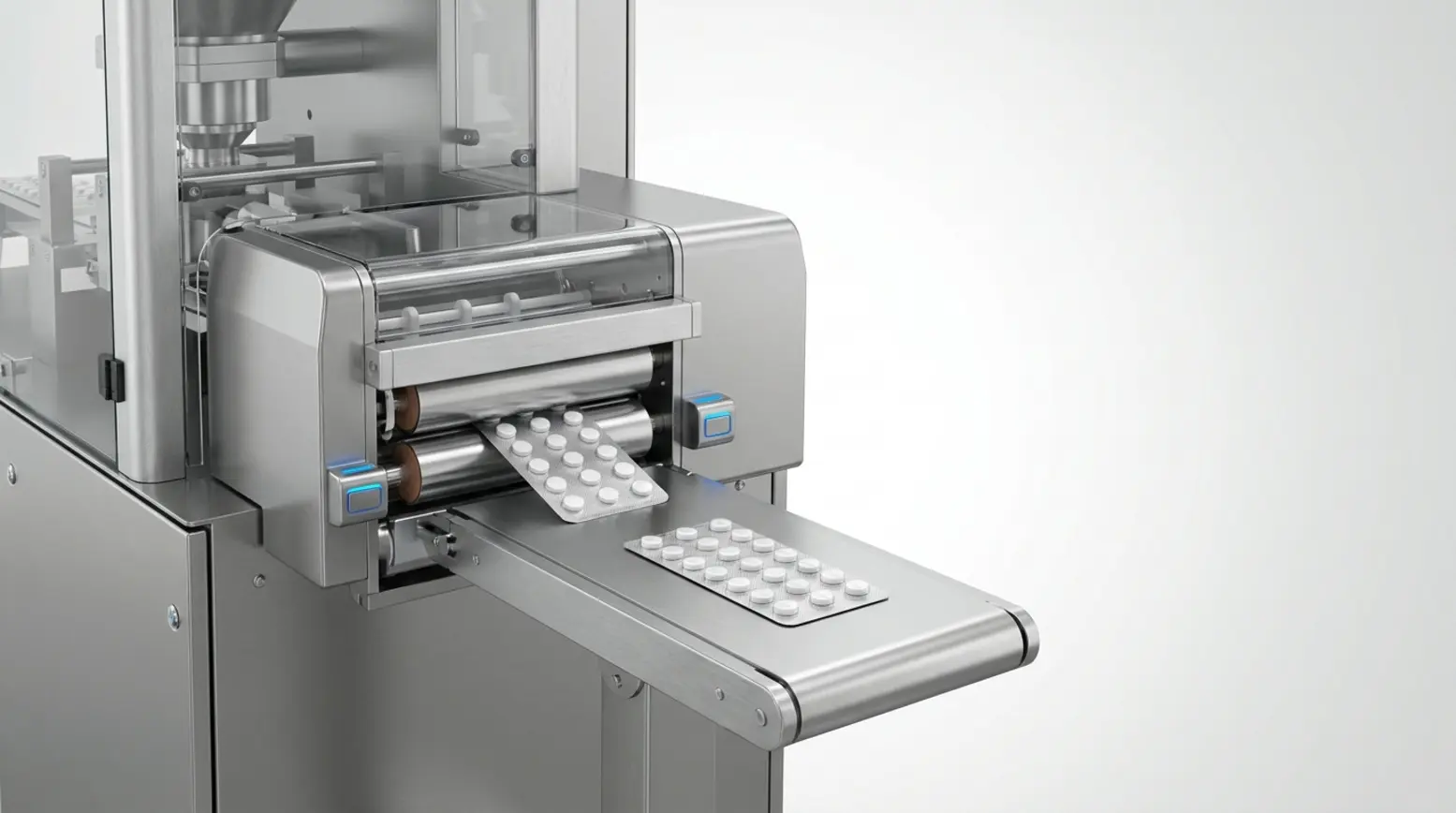
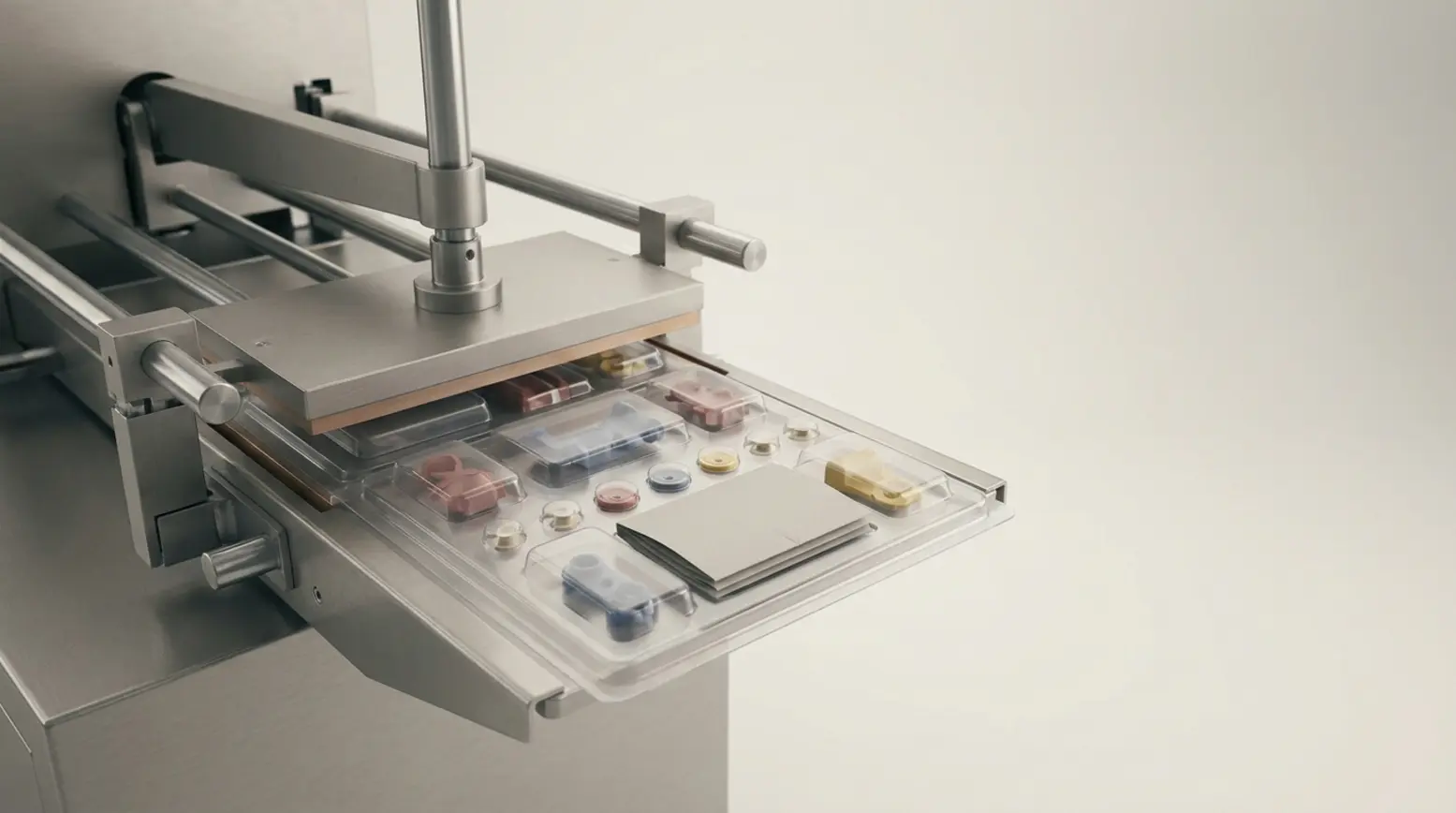
Blister pack shelf presentation: choosing the right machine


Blister pack shelf presentation should be defined before machine selection because shelf behavior becomes a strict production requirement. If a pack must hang, stand, or stack in a specific way, the tooling, sealing process, feeding method, and machine type must consistently support that result. This is the practical starting point for retail blister projects, as a pack that looks perfect in a drawing can still fail after sealing, packing, transport, or store placement.
• Define early whether the pack must hang, stand, or stack, as this directly shapes the machine brief.
• Use a physical sample or detailed drawing so that shelf needs can be effectively translated into tooling and feeding requirements.
• Check seal consistency and blister card rigidity, since both heavily impact retail pack presentation and overall repeatability.
• Match the equipment to the pack's behavior, production volume, and automation requirements to keep the process stable.
• Test repeated retail handling with the actual pack before final approval, as weak points frequently appear later in the process.
Shelf presentation: how the pack must behave in-store for successful blister pack shelf presentation
Good shelf presentation starts with clearly defined pack behavior. A retail blister pack must maintain its orientation and shape after sealing, case packing, transport, and store placement. This applies equally to hanging retail packaging, free-standing packs, and retail blister displays that must stack neatly in a tray or shelf-ready packaging system. If these factors are not established early on, machine selection becomes challenging, and costly tooling changes are far more likely. If you need a foundational overview first, our comprehensive guide to blister packaging explains the core components and how these packs are built.
Why blister pack shelf presentation should be defined before machine selection
Phrases like "hangs well," "stands well," and "stacks well" describe physical pack behavior; they are not merely visual observations. When planning blister pack shelf presentation, these specific points must be written into the machine and tooling brief, as the finished pack needs to achieve the exact same result repeatedly. A highly useful brief includes the intended orientation, outer dimensions, display fit, forward-facing retail direction, and any areas requiring extra support. Providing samples and drawings is incredibly helpful because they practically connect store requirements with sealing, feeding, and tooling choices.
A simple way to document this is to write down exactly what the pack must do, what could go wrong, and what the machine must control. This approach makes the entire project much easier to review across engineering, operations, procurement, and production teams.
• Hanging: The pack must remain straight on the hook, meaning the position of the hanging feature and the structural strength of the top area must be carefully defined.
• Standing: The pack must support itself; therefore, base stability, seal consistency, and overall product balance must be well defined.
• Stacking: The pack must maintain repeatable outer dimensions, making tight size control and tray compatibility essential requirements.
Blister pack shelf presentation for hanging packs
Position of the hanging feature
A hanging blister pack requires its hang hole or slot to be placed perfectly for the intended orientation. If the feature is too high, too low, or off-center, the pack will likely lean or rotate. This directly impacts blister pack display quality and can even alter how the product faces shoppers in the store. Therefore, technical drawings should clearly indicate the hanging position, the facing direction, and the expected orientation during normal retail handling.
Stability around the hanging area
The area surrounding the hang feature requires substantial support because this section endures the most stress during transport, handling, and daily store use. Blister card rigidity is crucial here. Since rigidity depends on both board construction and pack geometry, placing a large product cavity near the top or utilizing a narrow card shape can severely reduce stability. In some cases, adding more material or opting for a different layout might help, but these changes will also influence tooling and feeding mechanics.
Production points to define
Unusual shapes can be significantly harder to run on automatic equipment since the card often feeds less smoothly. Narrow tops, curved edges, or fold-out features can all make the card less stable while traveling through the machine. Furthermore, seal consistency is vital around the upper area; weak or uneven sealing can drastically change pack behavior once the product is packed and in transit. For this reason, we strongly advise testing repeated handling with real samples. A pack might look correct initially, but its hanging position can quickly shift after just a few handling steps.
One practical example involves a hanging retail packaging format featuring a large product cavity near the top. The pack might look perfectly balanced on a sample board, yet after sealing and transport, it could noticeably tilt on the retail hook. This illustrates exactly why the machine brief must include orientation targets, designated support areas, and rigorous handling checks.
Blister pack shelf presentation for free-standing packs
Geometry that lets the pack stand
A free-standing pack must independently support itself in its intended position. This capability relies heavily on geometry, product weight, and where the blister cavity sits on the card. A standing blister packaging concept might require a wider base, a strategically folded support area, or another structural feature designed to keep the pack upright. The optimal format always depends on the specific product and the display requirements, meaning any standing requirement should be rigorously tested using the actual physical pack.
Seal quality and visible appearance
Seal quality dictates both appearance and function. If the seal is weak or uneven, the packaging may warp, lose its flatness, or sit awkwardly on the store shelf. This negatively changes the retail pack presentation and can severely reduce structural stability within a retail blister display. For standing packs, even minor variations can have highly visible effects because the design depends entirely on a stable base and a repeatable shape.
Seal process and format options
Heat sealing remains suitable for many conventional carded retail blisters. Alternatively, cold sealing uses pressure instead of heat, which can open up extra format options within our range, such as free-standing packs, multi-panel designs, or unique dispenser functions. Ultimately, the chosen sealing process must align with the format needs and overall production goals, as the machinery must completely support the way the pack is intended to behave in the store.
A simple example is a free-standing pack that appears perfectly stable immediately after sealing but shifts out of alignment following case packing. In such instances, the core issue often stems from poor geometry, inadequate support points, or inconsistent sealing. Therefore, the standing requirement must always be a key component of the machine review, not just an afterthought in the visual design phase.
Blister pack shelf presentation for stacking and shelf-ready packaging
Consistent outer dimensions
Successful stacking depends on highly repeatable width, height, and thickness. If the dimensions of individual packs vary too much, the stack can shift, lean, or simply fail to fit properly into the intended tray or shelf-ready packaging system. This matters significantly for blister pack shelf presentation because the final display result relies just as heavily on machine repeatability as it does on the initial pack design. Consequently, specifications must clearly outline the allowed outer dimensions and precisely identify the display system the pack needs to fit.
Structural stability in handling
Packs also require sufficient structural stability to survive their planned handling route. A stack might look perfect immediately following the sealing process, but unforeseen problems can easily emerge during case packing, long-distance transport, or in-store shelf refills. Retail pack handling dynamics and blister pack display conditions must be evaluated together; after all, the machine must produce a pack durable enough to survive the full journey to eventual store placement.
What to write into the specification
For stacking projects, the technical brief should explicitly detail the outer dimensions, facing direction, stacking methodology, and any tray or shelf-ready packaging requirements. If the pack functions as part of a larger retail blister display, the brief must also note how many packs fit into one display unit and how those packs will be removed or refilled by store staff. Providing these details gives both engineering and operations a much clearer baseline for finalizing tooling and setup decisions.
A practical example is a stacked retail blister display intended for a small consumer product. If the overall pack thickness fluctuates even slightly across a production run, the display tray might fill unevenly. Because this represents a machine performance issue just as much as a packaging design issue, repeatable output tolerances should be verified early on.
How blister pack shelf presentation affects tooling, feeding, and machine setup
Card rigidity, geometry, and material choices
Card rigidity stems primarily from board construction and physical geometry. If greater stiffness is required, the pack might necessitate a different layout or the addition of extra material in critical areas. While these adjustments can drastically improve shelf behavior, they will also alter how the card feeds through the system and how the necessary tooling is engineered. For blister pack shelf presentation, these inevitable trade-offs should be reviewed early, as even a minor design change can impact multiple stages of the manufacturing process.
When automation becomes harder
Automatic feeding naturally becomes more challenging when dealing with unusual card shapes or unstable presentation features. For instance, a card boasting very little support area is prone to shifting inside the feeder. Consequently, a shape specifically designed to elevate retail pack presentation might inadvertently introduce substantial production risks. If the initial pack concept is still evolving, it can be highly beneficial to compare broader packaging styles before finalizing the machine brief, as some layouts are inherently much easier to run consistently than others.
Optional functions only when needed
Vision systems, inline printing, and scanning modules can greatly enhance control and traceability; however, they should only be integrated when they fulfill a genuine production need. A simpler overall setup is frequently better if the primary requirements are merely stable sealing, reliable feeding, and highly repeatable output. Ultimately, the goal is to build a machine setup focused precisely on the actual pack behavior, rather than bolting on superficial functions that fail to support that core objective.
Choosing equipment for blister pack shelf presentation at different production volumes
Lower volume production
Manual tabletop units and shuttle equipment can be highly useful for lower production volumes, initial trials, and early-stage development work. These systems prove incredibly beneficial when the final format might still undergo changes, allowing teams to learn directly from real physical samples before committing to a much higher level of automation.
Growing demand
Rotary equipment usually fits growing demand perfectly because it supports higher output volumes alongside a controlled, highly repeatable process. Upgrading to rotary machinery is an excellent step forward when pack behavior is already clearly established and the primary goal is scaling up production without sacrificing consistency.
Higher volume requirements
Fully automated rotary, carousel, or inline equipment will typically suit higher volume requirements, provided the pack design itself intrinsically supports stable feeding and repeatable sealing. Critically, as the level of automation increases, fundamental pack stability becomes increasingly important; on faster lines, even minor format issues can trigger significant production interruptions over time.
Machine selection depends on three things
Machine selection should always be guided by three distinct factors: intended shelf behavior, target production volume, and specific automation requirements. Once these parameters are entirely clear, it becomes much easier to evaluate and select the right retail packaging machines for the job at hand. By following this approach, the equipment choice perfectly aligns with the actual needs of the pack, rather than attempting to force the pack to fit the machine later on.
From pack idea to machine implementation
Build the brief with real pack behavior
It is always best to kick off a project using either a real physical sample or a crystal-clear technical drawing. Doing so helps cross-functional teams define both shelf behavior and production requirements collaboratively. We actively support this step because we deeply understand both the packaging materials side and the machinery side, ensuring your project seamlessly transitions from a retail concept to a workable setup with far fewer risky assumptions. This dual expertise proves especially useful when the pack must maintain a strict hanging orientation, stand firmly after sealing, or slot into a highly precise retail display system.
Why machine implementation matters
Selecting the right machine is only one piece of the larger project puzzle. Proper installation, seamless line integration, and ongoing post-delivery support also matter immensely since the machinery must operate flawlessly within a real-world production environment. Because future format changes will inevitably create new setup questions, it drastically helps to keep engineering, tooling, and implementation fully connected right from the start.
How the full process stays connected
Our holistic approach to machine implementation carefully details how installation, integration, and ongoing support work together in everyday practice. Grasping this connection is important because even an excellent equipment choice still strictly requires the correct on-site setup, proper operator training, and the right technical follow-up whenever packaging formats evolve.
Questions to ask before you approve a retail blister format
Before granting final approval, always ask whether the pack maintains its correct orientation after repeated handling. Ensure the required hanging, standing, or stacking behaviors are explicitly written into the tooling brief. Verify that the seal remains consistent enough to guarantee highly repeatable shelf presentation, and confirm that the selected level of automation realistically fits the chosen pack shape and production volume. Additionally, it is highly useful to ask whether the project would benefit from a sample review or a free Quick Scan before any equipment is officially ordered; performing early checks frequently reveals hidden format risks long before they turn into expensive machine problems.
Practical next steps for blister pack shelf presentation projects
If your project remains in its early stages, bring us a real physical sample or a comprehensive drawing so we can help define exactly how the pack must behave on the retail shelf. A free Quick Scan can easily review your proposed format, identify likely production risks, and map out the ideal equipment path well before any final machine purchasing decisions are made. If your specific shelf presentation and production requirements are already fully known, please contact us today so we can begin discussing the ideal next steps for your facility.
FAQ
What is the first step in blister pack shelf presentation planning? The crucial first step is clearly defining how the pack must behave inside the actual retail store. You should explicitly describe whether the pack needs to hang, stand, or stack, alongside exactly how it should face outward on the shelf. Clarifying these points instantly gives the machine engineering brief a concrete, actionable starting point.
Why does seal quality matter for shelf presentation? Seal quality directly dictates both overall pack shape and structural stability. If the seal proves weak or uneven, the final pack will likely look distorted, stand far less securely, or handle poorly following production and subsequent transport.
Can unusual pack shapes run on automatic equipment? Yes, but the feeding process generally becomes noticeably harder. This dynamic must be checked early in the project lifecycle because unusual card shapes frequently compromise tooling design, overall card stability, and the level of automation that is realistically achievable.
Should we choose the machine before the pack format is fixed? Usually, no. It is far better to fully define the intended pack behavior and all primary format needs first, as these specific data points must guide all subsequent machine, tooling, and feeding choices.
When is a Quick Scan useful? A Quick Scan is highly useful at an early project stage, particularly while the core pack concept is still under active review. Utilizing this tool helps neatly connect desired shelf behavior, potential production risks, and ideal machine direction long before any final, binding decisions are made.